
Same Battery, Twice the Revenue
THE CHALLENGE
A 10 kW rooftop system at 52° north faces major seasonal swings, from summer surplus to winter shortages. With no grid feed-in capacity, every stored kilowatt-hour counts. Yet fixed schedules cannot adapt to changing electricity prices throughout the day, missing opportunities to charge low and discharge high.
THE SOLUTION
In June 2026, AI Saving was activated in elekeeper to optimise the 50 kWh HS5 EK90 system. Every 15 minutes, it adjusts charging and discharging strategies based on Nord Pool NL electricity prices, weather forecasts and household consumption patterns to maximise energy savings.
THE RESULTS
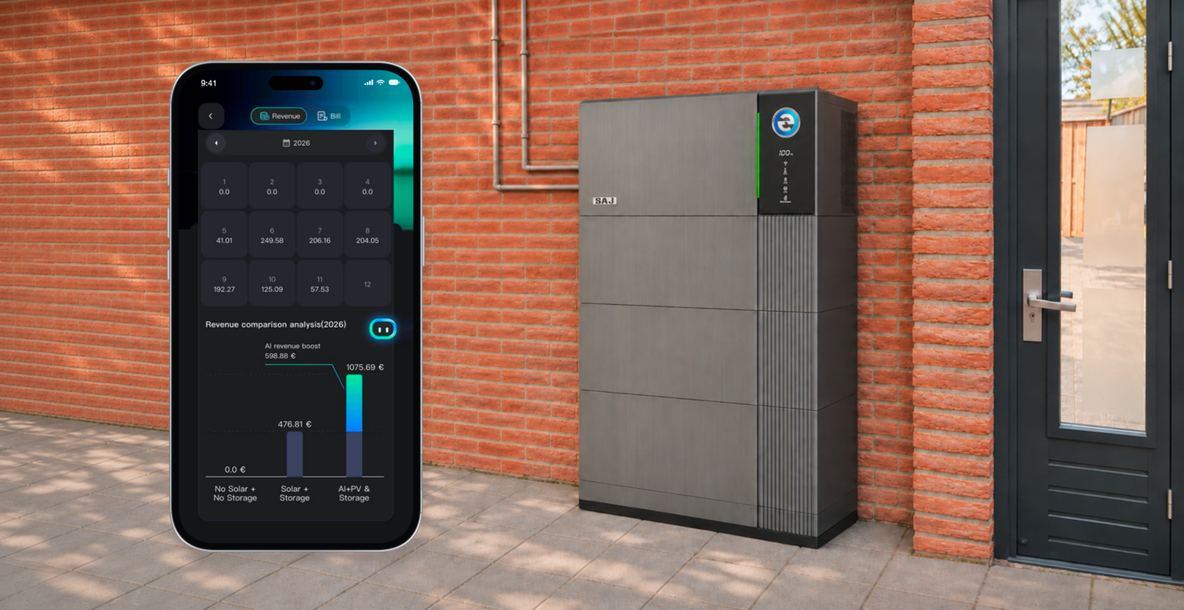
Over seven months, AI Saving increased energy savings from €476.81 to €1,075.69, delivering €598.88 more value (+126%) using the existing system, with no additional solar panels, inverter or battery capacity.
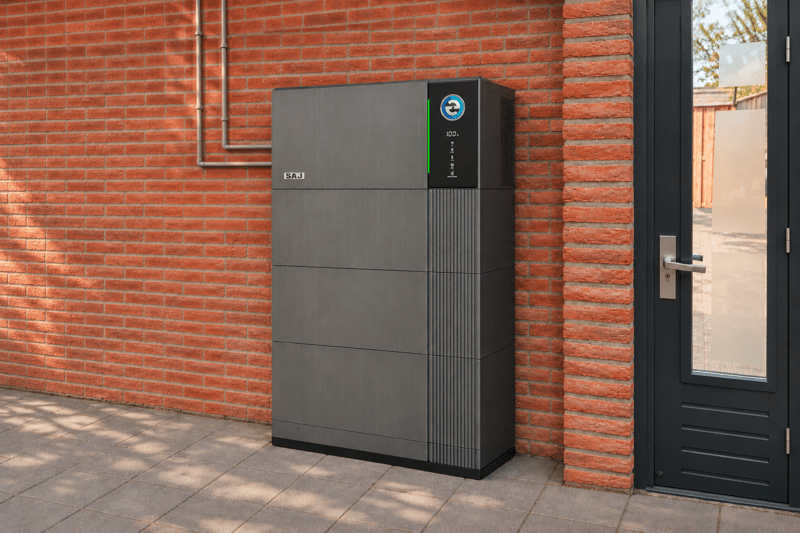
The SAJ HS5 EK90 all-in-one energy storage system
At 4:30 in the morning, electricity in the Netherlands can cost next to nothing.
On 18 November 2026, Nord Pool NL prices dropped to around €0.065/kWh at their lowest. By late afternoon, they had climbed to €0.22/kWh, staying above €0.20 until almost 10 pm.
For most households, that's simply the cost of using electricity. But this home has a different way to play the market.
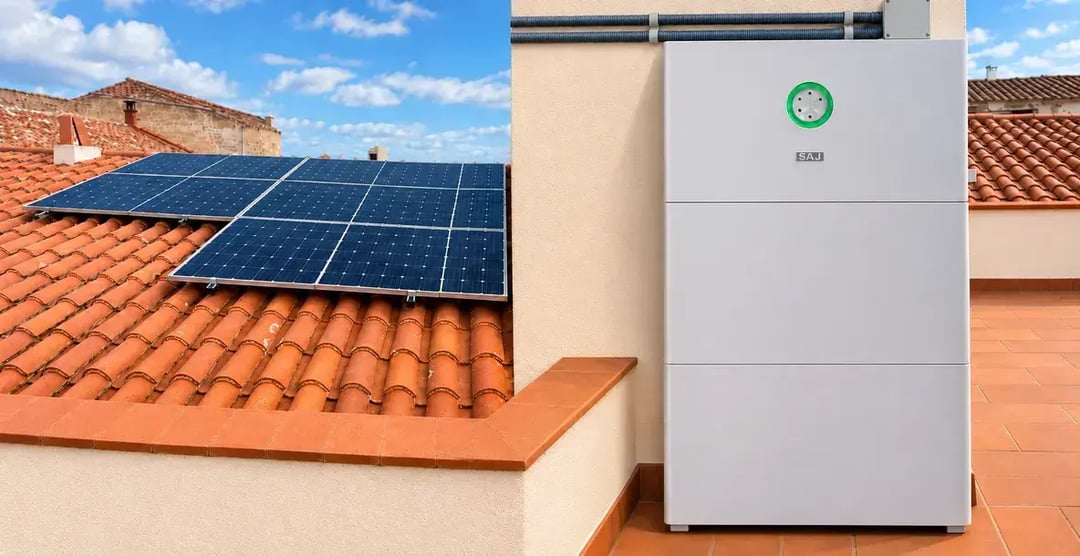
On the roof: 10 kW of solar. On the outdoor wall: a 10 kW inverter and 50 kWh of battery storage, powered by an SAJ HS5 EK90 installed in May 2026.
But there's a catch.
This home cannot export a single kilowatt-hour to the grid. Every bit of surplus solar energy must be put to use at home or stored for later.
At a glance
| Location |
Amsterdam, Netherlands |
| Application | Residential |
| System | SAJ HS5 EK90 All-in-One Solution (10 kW + 50 kWh) |
| Configuration | 10 kW PV / 50 kWh storage |
| Tariff | Dynamic import price, NordPool NL, 15-minute settlement |
| Software | elekeeper with AI Saving |
| Result | €1,075.69 revenue vs €476.81 without AI (+126%) |
The Meter Only Runs One Way
On paper, a solar-powered home has two ways to make the most of its energy: use it or sell the surplus.
This home has only one.
Its grid connection does not allow electricity exports, a growing challenge in the Netherlands as local grid congestion increasingly limits feed-in. Once the battery is full, any remaining solar generation has nowhere to go. The panels keep producing, but the surplus cannot be used or sold. It is simply wasted.
This changes the role of battery storage entirely.
Without the option to export, the battery becomes the only way to carry daytime solar energy into the evening. Every kilowatt-hour it fails to store is potentially another kilowatt-hour the household must buy from the grid later, often at a higher price. The value is not in what the system sells, but in what the household no longer needs to buy.
No software can create an export connection where none exists. But intelligent energy management can make better use of every available opportunity: storing surplus solar before the battery reaches capacity, charging from the grid when prices are low, and discharging when electricity becomes expensive.
The real question is no longer just how much energy the battery can store. It is whether that energy is stored, used and released at exactly the right time.
Fifty-Two Degrees North
At 52 degrees north, the Netherlands has a very different relationship with solar energy in summer and winter. And that changes what a home battery needs to do.
In June, daylight lasts nearly 17 hours. In December, less than 8. For a typical 10 kWp rooftop system, that means over 1,000 kWh of solar generation in midsummer, but only around 200 kWh in midwinter. When solar production falls to just 5–8 kWh a day against household consumption of nearly 30 kWh, solar alone is nowhere near enough.
In this climate, a home battery needs to do more than store sunshine.
First, capture the summer surplus. When the roof produces more than the household can use, the battery stores the excess for the evening, making the most of every available kilowatt-hour.
Second, provide flexibility through winter. With solar generation at its lowest, the grid supplies most of the household's energy. A 50 kWh battery can help shift energy use away from expensive periods, providing greater flexibility when solar alone cannot meet demand.
Third, make every electricity price count. With prices changing every 15 minutes, AI Saving can charge the battery when electricity is cheap and discharge when prices rise. In summer, this adds value to the solar energy already stored. In winter, when sunshine is scarce, it creates another opportunity to reduce electricity costs.
Because when the sun has little to offer, knowing when to buy and when to use electricity matters even more.
A Battery Waiting for the Sun
For most of its life, a home battery does one job. It waits for noon, takes the surplus the roof cannot use, and gives it back after dinner. It is a sensible job, and it is the reason most systems are sold.
It is also, on a dynamic tariff, a job that leaves thirteen hours of every day untouched.
Under that fixed strategy, Hendrik's system earned €476.81 between May and November. That is not nothing: it is the honest value of moving solar from midday to evening. But it is the value of a single window, in a market that opens a new one every fifteen minutes.
96 Opportunities Every Day
In the Netherlands, electricity prices change every 15 minutes, creating 96 different price opportunities every day.
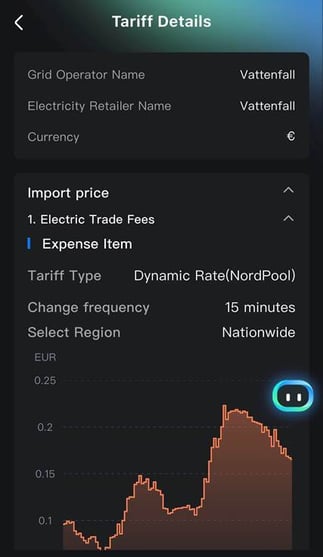
The dynamic tariff details on elekeeper interface
AI Saving analyses these prices alongside weather forecasts and household consumption patterns, automatically deciding when to store solar energy, charge from the grid, hold energy or power the home.
For a home without grid feed-in, two strategies make the biggest difference.
First, charge when electricity is cheap. When prices drop overnight, AI Saving charges the battery from the grid, storing low-cost energy for use during expensive morning hours.
Second, make room for the sun. Instead of keeping the battery full until evening, AI Saving can discharge stored energy to power the home in the morning. This frees up capacity for surplus solar generation around midday, allowing the battery to charge again before the evening peak.
Two opportunities to discharge in one day, instead of just one. More energy used, more savings captured, without adding any hardware.
No need to monitor electricity prices or adjust schedules manually. AI Saving handles the decisions and timing automatically.
"I used to think fifteen-minute prices were a trader's detail. It turns out that is what decides whether there is room in the battery when the sun comes up, and how little I have to buy after dark."
— Hendrik, homeowner
Two Curves, One Battery
By the end of November, the dashboard reads €1,075.69 under AI + PV & Storage, against €476.81 for Solar + Storage alone. The difference of €598.88 is the price of scheduling on hardware that did not change by a single panel.
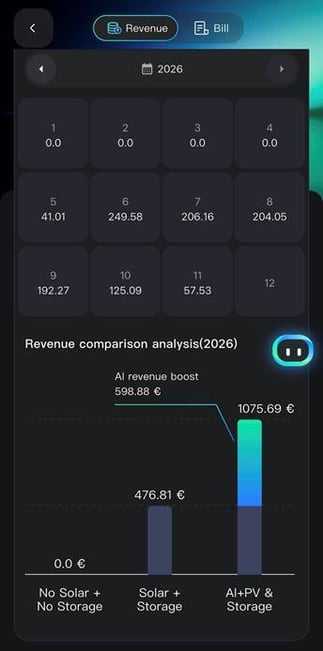 The revenue statistics displayed on elekeeper interface
The headline figure tells only part of the story. The more interesting difference lies in how the two strategies perform over time.
The existing solar panels were already in place when the SAJ system was installed in May 2026. The HS5 EK90, combining a 10 kW inverter with 50 kWh of battery storage, was mounted on the exterior wall of the house. During its first month, it followed a conventional approach: storing surplus solar energy and releasing it after dark.
Then, in June, Hendrik activated AI Saving in elekeeper, changing how the system managed energy throughout the day.
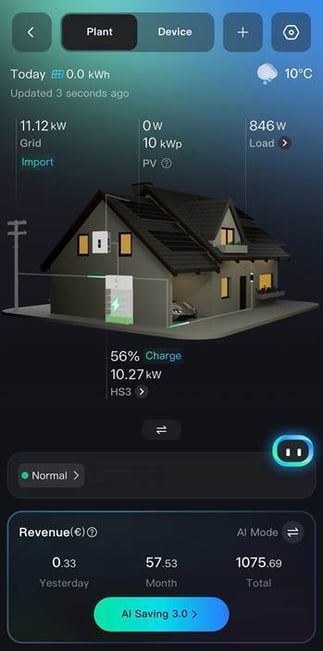 Activate AI Saving on the main interface
That moment marks the turning point in the results.
May provides the clearest baseline: the same battery, roof and tariff, with AI Saving still switched off. Both strategies delivered exactly €41.01.
June was the first month with AI Saving enabled, and the difference was immediate. Savings reached €249.58 with AI, compared with €72.15 without it, more than 3.5 times as much.
From July onwards, the advantage remained consistent, with AI Saving delivering 2 to 2.5 times more savings every month.
The AI + PV & Storage revenue statistics displayed on elekeeper interface
The PV & Storage only revenue statistics displayed on elekeeper interface
| Month | Solar + Storage | AI + PV & Storage | Difference | Ratio |
| May | €41.01 | €41.01 | — | 1.00 |
| Jun | €72.15 | €249.58 | +€177.43 | 3.46 |
| Jul | €99.11 | €206.16 | +€107.05 | 2.08 |
| Aug | €94.87 | €204.05 | +€109.18 | 2.15 |
| Sep | €92.25 | €192.27 | +€100.02 | 2.08 |
| Oct | €54.44 | €125.09 | +€70.65 | 2.30 |
| Nov | €22.98 | €57.53 | +€34.55 | 2.50 |
| Total | €476.81 | €1,075.69 | +€598.88 | 2.26 |
Compare the two curves side by side, and a more interesting pattern emerges: the difference is not just in the amount saved, but in what drives the results.
The baseline peaked in July at €99.11, largely following solar generation. AI Saving, however, peaked in June at €249.58, before declining through the summer even as the baseline continued to rise. June alone accounted for nearly 30% of the total additional savings.
That's because AI Saving responds to more than solar production. Its performance depends on both the energy available and the gap between the day's lowest and highest electricity prices. June offered the most favourable combination, outperforming July despite lower solar generation.
The Darkest Months Make the Strongest Case
Look at how the advantage changes as the year progresses.
July: 2.08x. August: 2.15x. September: 2.08x. October: 2.30x. November: 2.50x.
The pattern is clear: AI Saving's relative advantage grows as solar generation declines. For a household with no grid export option, this matters. As summer ends, there is less surplus solar to work with, but more opportunity to benefit from flexible grid charging.
November brings this into focus. With daylight down to around eight hours, the baseline savings had fallen to €22.98, 77% below the July peak. AI Saving's contribution also declined, reaching €57.53. But it remained 2.5 times the baseline.
The reason is simple. When solar production cannot cover household demand, the battery can still charge from the grid during cheaper periods and supply the home when electricity prices rise. Instead of relying solely on sunshine, it can respond to the changing price of energy throughout the day.
That is the bigger story: the value of a battery is not just how much solar energy it stores, but how intelligently it manages energy from every available source.
What the Battery Actually Did
The energy data reveals how this strategy worked.
Across the seven-month period, the two solar arrays generated 4,953 kWh, while the household consumed 5,774 kWh. The battery recorded 7,162 kWh of charging energy and 5,474 kWh of discharged energy.
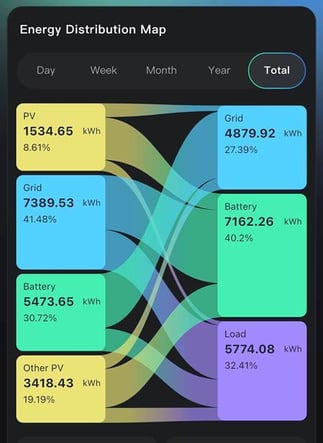
The energy distribution map displayed on elekeeper interface
The battery's charging total exceeded the solar generation of both arrays. This points to an important part of the system's operation: it was not relying on solar alone. It also charged from the grid, taking advantage of lower electricity prices when solar production was insufficient or grid energy was more economical.
The figures show that the battery was doing more than storing excess rooftop solar. It was also helping the household make better use of the electricity market, turning flexible charging and discharging into additional savings.
What Hendrik Sees
The last piece is not the battery. It is the screen.
"I stopped checking prices. The system charges at night when it is cheap and sells in the evening when it is expensive — I only open the app to see what it made."
— Hendrik, homeowner
Most energy apps show you the numbers. elekeeper shows you what drives them: generation from each PV array, grid import and export, battery charging and discharging, and household consumption. It then goes one step further, separating the savings from solar and battery operation from the additional value delivered by AI Saving.
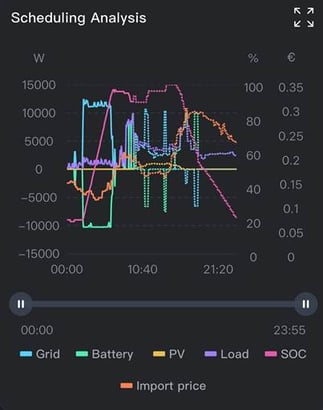
The AI scheduling analysis displayed on elekeeper interface
"What convinced me was that the app shows the difference. I can see what the panels and the battery earned by themselves, and what the AI added on top. That second number is not small."
— Hendrik, homeowner
The electricity tariff settings are just as transparent. The app lets users configure fixed, time-of-use or dynamic pricing, with the utility provider, country, price update frequency and trading fee all visible in one place.
For a home with no feed-in option, this visibility matters. There are no export earnings to factor in. Every euro saved comes from electricity the household no longer needs to buy from the grid.
The Lesson Behind the Numbers
The headline result is €598.88 in additional savings. But the more telling figure is 2.26x.
Same solar array. Same inverter. Same battery. Same tariff. Yet AI Saving delivered more than twice the savings of the fixed strategy by allowing the battery to respond to multiple price opportunities throughout the day.
With 50 kWh of storage, value is not determined by capacity alone. It also depends on when the battery charges, when it discharges and how flexibly it responds to changing electricity prices. A larger battery stores more energy. A smarter strategy makes better use of every kilowatt-hour.
For a household that cannot export electricity, this distinction is fundamental. The value of storage cannot depend on summer solar surplus alone. It must also come from buying electricity when prices are low and using it when prices rise.
The real advantage is not simply having more energy to store. It is knowing when to use it.
Revenue figures are as reported by the elekeeper dashboard for May–November 2026, the period from commissioning to the date of writing. Price examples are taken from the NordPool NL day-ahead curve for 18 November 2026 as displayed in the app. Seasonal yield figures are indicative values for the Netherlands at this latitude and vary with orientation, shading and weather. Results depend on system size, tariff structure, market prices, weather and household consumption; they are not a guarantee of future performance. "AI-attributed revenue" is the difference between the AI + PV & Storage and Solar + Storage scenarios as calculated in the app. Customer quotations are draft copy pending written approval.